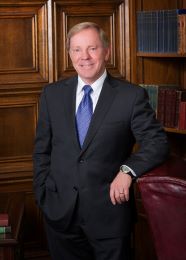
A passionate lawyer dedicated to suicide prevention
With a legal background ranging from duties as a U.S. Air Force Courts Martial Judge to services as Texas’ top drug traffic prosecutor, Skip Simpson is a lawyer who has covered a wide range of intriguing matters, both civil and criminal. At the Law Offices of Skip Simpson, he now focuses primarily on psychiatric and psychological malpractice, although he rules no case out.
Nationally recognized for his expertise in suicide, he has also successfully defended clients in commercial litigation and toxic torts lawsuits. A natural curiosity and an obsession with gathering background research have given him opportunities to handle cases in groundbreaking fields of the law.
Profiled in The Wall Street Journal in 1997 for his pioneering work in suicide litigation, Simpson has been most active in cases where psychiatry and mental health questions have arisen. But his personal background reveals a varied career with stints as a military prosecutor, defense lawyer and general courts martial judge; a state and federal criminal prosecutor; an in-house trial lawyer for Southwestern Bell, and, a privately practicing civil litigator.
A commitment to public service
Officially named Texas’s top narcotics prosecutor in 1985, he launched his legal career from a position in the U.S. Air Force, which put him through law school at St. Mary’s University in San Antonio. After earning his law degree in 1974 – five years after joining the Air Force – Simpson became a military prosecutor and handled numerous criminal cases of recruit abuse by training instructors at Lackland Air Force Base. Later, he served as a military defense counsel and handled numerous insanity cases, which stimulated his curiosity in the mental health legal arena.
Although Simpson left active duty in 1981 to join the Dallas County District Attorney’s office, the U.S. Justice and Defense departments teamed up one year later to recall Major Simpson for service as a special prosecutor investigating public integrity issues in the military. Highlights of that tenure included the conviction of the highest ranking civilian in the military in Texas.
Moving to the U.S. Attorney’s office in Dallas, he won recognition in 1985 from the Texas Narcotics Officers Association and Texas businessman H. Ross Perot as the state’s most effective narcotics prosecutor that year. He left the U.S. Attorney’s office to accept a position as a trial lawyer for Southwestern Bell Telephone Company in 1985. He launched his own law firm in 1987.
A leading expert in legal issues related to psychological problems
With an interest in psychology, he’s become one of the nation’s leading experts on the legal aspects of psychological problems, handling numerous cases that deal with everything from use of false memories and multiple personalities to satanic cult worship and suicide. Simpson settled the first case ever brought by a sexual abuse “retractor” against her therapist based on repressed memory issues.
He also won a $3 million jury verdict against a neurologist accused of causing a suicide through the prescription of depression-invoking medications and negligent follow-up to the patient’s complaints. In 1996, he scored a $40 million verdict in an intellectual property and breach of contract dispute largely by preventing a key psychologist from testifying against a corporate client. Again in 1997, he scored a $5.9 million verdict in another mental health case. Skip Simpson’s legal career abounds with such successful verdicts for his clients.
Simpson does not take credit for the large verdicts. The facts of the cases cause the large verdicts. Juries fully understand they are the collective conscience of the community … not simply twelve individual opinions. Juries understand their verdicts help to keep their communities safe by requiring psychiatric hospitals and clinicians to practice safely.
Passing his knowledge down to students
In recognition as a leader in the mental health field, Mr. Simpson received an academic appointment in 2003 as a Research Associate of the Program in Psychiatry and the Law, Department of Psychiatry, Beth Israel-Deaconess Medical Center, Harvard Medical School.
On January 1, 2004, he was appointed as a Clinical Instructor at The University of Texas Health Science Center in San Antonio, Texas. As Clinical Instructor, Mr. Simpson taught medical residents subjects focusing on psychiatry and the law. In 2006 Mr. Simpson was promoted to Adjunct Associate Professor. In 2005 Mr. Simpson was named to the board of directors for the National Alliance for the Mentally Ill in Collin County where he served for several years.
SEARCY L. SIMPSON, JR.
CURRICULUM VITAE
Personal Data
Address:
Skip Simpson, J.D.
Law Offices of Skip Simpson
2591 Dallas Parkway, Suite 300
Frisco, TX 75034
214-618-8222 (voice)
214-618-8242 (fax)
Website: www.skipsimpson.com
Email: ssimpson@skipsimpson.com
Educational background
Mr. Simpson received his Bachelor of Arts in psychology, with minors in government and sociology, from Texas A&M University, Kingsville, Texas, in 1969.
He received his Juris Doctor from St. Mary’s School of Law, San Antonio, Texas, in 1975.
Legal licenses
United States Court of Appeal – Fifth Circuit (1982 – present)
United States Court of Military Appeals (1975 – present)
United States District Court – Northern District of Texas (1982 – present)
Eastern District of Texas (1992 – present)
Southern District of Texas; (1995 – present)
The Supreme Court of the State of Texas (1975 – present)
Principal responsibilities and professional activities
1987-present: Private Practice
1986-1987: Assistant General Counsel; Trial Counsel, Southwestern Bell Corporation, Dallas, Texas
1983-1989: General Counsel’s office advisor, Army and Air Force Exchange Service
1983-1985: Assistant United States Attorney, Northern District of Texas
1981-1982: Dallas County Assistant District Attorney
1969-1981: United States Air Force Regular Officer
Missile Combat Crew Officer
General’s Aide-de-Camp
Judge Advocate
Air Force Circuit Trial Counsel
Air Force Circuit General Courts-Martial Judge
Academic appointments
2019: Faculty – National Suicidology Training Center, Baton Rouge, Louisiana.
2006-2016: Adjunct Associate Professor, Department of Psychiatry, The University of Texas Health Science Center at San Antonio, Texas.
2004-2005: Clinical Instructor, Department of Psychiatry, The University of Texas Health Science Center at San Antonio, Texas.
Honors and awards
National Top Trial Lawyers, Top 100, Civil Litigation, 2022 – Present
AVVO Rating: 10.0 Superb Lawyer
Multi-Million Dollar Advocate Forum: 2011-2020
AV Preeminent Martindale-Hubbell (Highest Possible Rating in Both Legal Ability & Ethical Standards): 2011-2017
Biltmore Who’s Who among Executives and Professionals, 2011 Edition
Life member of National Registry of Who’s Who published in 2000 Edition
Million Dollar Advocates Forum: 1997
Who’s Who in American Law: 1988
Who’s Who in Texas: 1985 – from the Who’s Who Historical Society
Dallas Police Department: Certificate of Merit – 1985
Drug Enforcement Administration Certificate of Appreciation: 1985
Top Narcotics Prosecutor for Texas – 1985; Presented by Ross Perot and The Texas War Drugs Committee
Freedom Foundation at Valley Forge Award for authoring Freedom Has a Price, 1973
Professional memberships/associations
American Association for Justice, Member
Texas Trial Lawyers Association, Member
The Texas Center for Legal Ethics and Professionalism
Dallas Bar Association, 1994-2019
San Antonio Trial Lawyers Association
San Antonio Bar Association, 2020-present
The QPR Institute, Inc., board member
The QPR Institute, Inc., faculty member, 2019-present
American Association of Suicidology, member
American Association of Suicidology, Board Member, 2015-July 30, 2021
Special Projects:
Various consulting duties for Suicide Prevention Resource Center and National Action Alliance for Suicide Prevention
Consensus Guide for Emergency Departments
Recommended Standard Care for Propel with Suicide risk: Making Health Care Suicide Safe
COVID Guidance: Screening for Suicide Risk During Telehealth Visits.
American Foundation for Suicide Prevention
National Alliance on Mental Illness (NAMI)
International Initiative for Mental Health Leadership (IIMHL)
National Suicidology Training Center (NSTC) – Faculty, 2019-present
Publications
Simpson, S: The Plaintiff’s Perspective: Avoiding the Malpractice Snare. “Malpractice and Liability in Psychiatry,” (Ash, Frierson, Friedman) Springer Publications, 2022, Chapter 7.
Reid, WH, Simpson SL, The Right Way to Avoid Malpractice Lawsuits, “Psychiatric Times,” September 2020
Simpson SL, Reid WH. Clinician testimony in suicide litigation: A cause to be uneasy. “Behavioral Sciences and the Law,” June 2019
Stanley, I. H., Simpson, S., Wortzel, H. S., & Joiner, T. E. Documenting suicide risk assessments and proportionate clinical actions to improve patient safety and mitigate legal risk. “Behavioral Sciences & the Law.”
Joiner, TE, Simpson S, et al. Whether Called Acute Suicidal Affective Disturbance or Suicide Crisis Syndrome, a Suicide-specific Diagnosis Would Enhance Clinical Care, Increase Patient Safety, and Mitigate Clinician Liability. 2018 “Journal of Psychiatric Practice”; 24:274-278
Suicide Prevention Resource Center. (2015). “Caring for adult patients with suicide risk: A consensus guide for emergency departments.” Waltham, MA: Education Development Center, Inc. Acknowledged as contributing his time and expertise to the development of this resource.
Chapter 13: “A Lawyer’s Perspective on Forensic Mental Health Experts” in Reid WH, Developing a Forensic Practice: Operations and Ethics for Experts. New York: Routledge (Taylor & Francis). 2013
How Lawyers View Psychiatric Experts, “Journal of Psychiatric Practice,” 2012; 18:444-447, Reid, WH and Simpson, SL
TLAP News, Tennessee Lawyers Assistance Program, Preventing Suicide: A Challenge to the Legal Profession, Fall 2009
Preventing Suicide: A Challenge to the Legal Profession, “GPSolo,” a publication of the American Bar Association, Simpson S, Quinnett P, Vol 25, number 7, October/November, p. 60, 2008
Attorneys’ Requests For Complete Tax Records From Opposing Expert Witnesses: Some Approaches to the Problem, Gutheil TG, Simon RI, Simpson S, “American Academy of Psychiatry and Law,” Vol. 34, p. 518, 2006
Mental Treatment Issues and Suicide ATLA Professional Negligence Section, Vol. 11, No. 3, Spring 2004
Avoiding the Malpractice Snare: Documenting Suicide Risk Assessment, “Journal of Psychiatric Practice,” Vol. 10 No. 3, May 2004
Shrink Rap: An Introduction to Mental Health Malpractice (co-authored with Jerry Meek) “South Carolina Lawyer,” 2001
Preventing Suicide through Improved Training in Suicide Risk Assessment and Care: An American Association of Suicidology Task Force Report Addressing Serious Gaps in U.S. Mental Health Training.” American Association of Suicidology Task Force Member. Suicide and Life-Threatening Behavior, Vol. 42, Issue 3, pp. 292-304
Causes of Action Against Health Care Providers by Retractors of Abuse Allegations “Shepard’s Expert and Scientific Evidence Quarterly” (Fall 1994) (co-authored with Julie Kay Baker)
Presentations
Presentation: Avoiding the Malpractice Snare (Mass murder scenario) 8th Annual Conference on Suicide Kevin’s Song: Continuing the Conversation, Detroit, Michigan, January 26, 2024
“Suicide-specific Diagnosis enhancing Clinical Care, Increasing Patient Safety, and Mitigating Clinician Liability,” Detroit, Michigan, January 26, 2024
Webinar: Avoiding the Malpractice Snare. Grand Rounds New Hampshire State Psychiatric Hospital, November 16, 2023 (Lewiston, ME 10/25/23 analysis)
Webinar: Understanding a lawyer’s strategies for selecting or declining cases for clinician malpractice in a Zero Suicide climate. Mississippi State University, September 20, 2023
Webinar: Ethical and Legal Issues in Suicide Care. Co-Presenter: Understanding a lawyer’s strategies for selecting or declining cases for clinician malpractice in a Zero Suicide climate. Emory University, November 4, 2022.
Webinar: Understanding a lawyer’s strategies for selecting or declining cases for clinician malpractice in a Zero Suicide climate. Mississippi State University, September 27, 2022.
Webinar: Understand a lawyer’s strategies for selecting or declining cases for clinician malpractice in a Zero Suicide climate. Jefferson University, May 26, 2021
Webinar: Understand a lawyer’s strategies for selecting or declining cases for clinician malpractice in a Zero Suicide climate. Missouri Coalition for Community Behavioral Health, February 18, 2021
Webinar: Liability Issues in Suicide Care: A Lawyer Informed by Lived Expertise, United Survivors Webinar, November 19, 2020
Podcast: Suicide and Mental Health Malpractice, The Forensic Psychologist, America Out Loud Podcast, September 7, 2020.
Webinar Presentation: Resident training on Standards of care, suicide myths, and suicide trial dynamics. Johns Hopkins University School of Medicine, May 26, 2020
Webinar Presentation: Fellowship/Resident training on Standards of care, suicide myths, and suicide trial dynamics. SUNY, Rochester, NY, April 10, 2020
Presentation: Mental Health Issues for Lawyers, SBOT Labor and Employment Law Section. Houston, Texas, August 25, 2018
Webinar Presentation: Legal Aspects of Suicide Prevention \ Clinical Care and Defensive Practice, February 28, 2018, Missouri Coalition
Presentation: The Suicide Case – BTLG-MNIEG Meeting, – American Association for Justice Annual Convention, July 23, 2016, Los Angeles, California.
Webinar Presentation: Legal and Liability Issues in Suicide Care – Zero Suicide in Health and Behavioral Health Care – Co-Presenter – May 17, 2016
Presentation: “The Impaired Employee or Client – 23rd Annual Labor and Employment Law Conference. Austin, Texas, May 4, 2016
Presentation: “Thinking Failure – The Right Focus,” Annual Conference for Behavioral Health, Wichita, Kansas, September 17, 2015
Presentation: “Best Practices in Suicide Risk Assessment, Management and Support from a Lawyer’s Perspective,” Elevating the Conversation, Denver Colorado, February 26, 2015
Presentation: “Avoiding the Malpractice Snare,” UTHSCA, February 11, 2014
Presenter: AAS Training Summit, Washington, DC, January 9, 2014
“Anatomy of a Malpractice Case: Critical Legal & Psychiatric Issues,” Teleconference presentation to SUNY Upstate Division of Forensic Psychiatry, November 12, 2012
Presentation: 4th Annual Forensic Psychiatry Conference: Psychiatry Malpractice, “Avoiding the Malpractice Snare in New York,” SUNY Upstate Medical University, Syracuse New York, August 2012
Presentation: 7th Annual Mental Health Seminar, Grayson County, Texas, If Not Now, When? October 28, 2010
Presentation: American Academy of Psychiatry and the Law, 2010 Annual Meeting in Tucson, AZ. Panel: Robert Simon MD, Thomas Guthell, MD, James Knoll, MD , Skip Simpson JD, October 2010
Presentation: Suicide and the Law Arkansas Trial Lawyers Association Annual Conference, Eureka Springs, Ark, April 30, 2010
Presentation: Subtly Suicidal: Difficult Cases In Suicide Litigation, American Academy of Psychiatry and the Law, 2009 Annual Meeting in Baltimore, Maryland. Subtly Suicidal: Difficult Cases in Suicide Litigation. Panel: Thomas Guthell, MD, Jeffrey Janofsky, MD, Phillip Resnick, MD, Robert Simon MD, Skip Simpson JD, November 2009
Presentation: “Why Attorneys Are Different: Addressing Stress and Depression in the Legal Profession,” Dallas Bar Foundation, Dallas, Texas, June 5, 2009
Presentation: Lawyer2Lawyer and Legal Talk Network, The Impact of the Recession on Law Firms and Lawyers, May 20, 2009
Presentation for Crisis Center Follow Up Grantee Meeting at Substance Abuse and Mental Health Services Administration (SAMHSA), Maryland Headquarters. SAMHSA is a public health agency within the U.S. Department of Health and Human Services, March 12-13, 2009
Presentation: Policies and Guidelines for Imminent Risk, National Suicide Prevention Lifeline, New York, New York, January 23, 2009
Presentation: Avoiding the Malpractice Snare: 29th Annual Conference Association of Community Mental Health Centers of Kansas, Inc., Overland Park, KS, September 17, 2008
Presentation: Suicide Prevention and Lawyer Assistance, Memphis Bar Association Criminal Law Section, December 13, 2007
Presentation: Reducing Liability Exposure in the Psychiatric Practice, Texas Medical Association TexMed 2007, Dallas, Texas, April 27, 2007
Presentation: Suicidal Client & Clinician: Approach or Avoidance, American Association of Suicidology, 39th Annual Conference, American Association of Suicidology, Seattle, Washington, April 30, 2006
Presentation: A Therapist’s Nightmare: Being Sued After A Client Dies by Suicide, American Association of Suicidology, 39th Annual Conference, American Association of Suicidology, Seattle, Washington, April 28, 2006
Presentation: Suicide Awareness and Prevention, NAMI-Collin County Bipolar Awareness Day, Mental Illness Forum, Collin County Community College, Plano, Texas, October 6, 2005
Presentation: Suicide-If I had Only Known, NAMI Oklahoma 18th Annual Conference, Oklahoma City, May 5, 2005
Presentation: Post-Suicide Supervision: Practical and Legal Issues, 38th Annual Conference, American Association of Suicidology, Broomfield, Colorado, April 15, 2005
Presentation: Suicidal Client & Clinician: Approach or Avoidance, 38th Annual Conference, American Association of Suicidology, Broomfield, Colorado, April 14, 2005
Presentation: “Preventing suicide through family education; Exposing lethal secrets.” Harvard Medical School Program in Psychiatry and the Law at the Massachusetts Mental Health Center, Boston, Massachusetts, June 30, 2004
Presentation: Psychiatry and the Law; Interface between clinical and legal practice, UT Health Science Center, San Antonio, Texas, March 30, 2004
Presentation: Avoiding the Malpractice Snare: Rule #1, Document, UT Health Science Center, San Antonio, Texas, January 27, 2004
Presentation: From Standard of Care to Causation in Psychiatric Cases. Harvard Medical School Program in Psychiatry and the Law at the Massachusetts Mental Health Center, Boston, Massachusetts, November 6, 2003
Presentation: Avoiding Two Clinician Land Mines, Mental Health & The Law in Texas, Dallas, Texas, September 24, 2003
Presentation: Suicide and Mental Health Malpractice Dallas Bar Association, December 2001
Presentation: Treatment Issues and Suicide, Mental Health & The Law in Texas, Houston and Dallas, Texas, August 13-14, 2001
Texas-Oklahoma Joint Annual Convention, Double Tree Lincoln Centre, Dallas, Texas, September 7-9, 2000
Texas Association of Marriage & Family Counselors, Year 2000 Annual Growth Conference, Ethics for a New Millennium, Green Oaks Hospital, Dallas, Texas, February 26, 2000
Presentation: Standard of Care, Flow Psychiatric Facility, Denton, Texas, February 23, 2000
Don’t Ignore Symptoms of Mental Illness, The Dallas Morning News, November 27, 1999
Clinical Hypnosis Fall Workshop, Dallas, TX, October 1999
Clinical Hypnosis Spring Workshop, Dallas, TX, May 1999
Illinois High Court Upholds Contributory Negligence Defense in Failure to prevent Suicide Case. Personal Injury Lawcast Cassette, February 22, 1999
Eleventh Annual Clinical Hypnosis Workshop, Green Oaks Hospital, October, 1998
Monitor Them, The Dallas Morning News, August 2, 1998
Good Morning Texas (Channel 8-WFAA-TV, Dallas, TX)
Memory, Sexual Trauma & the Law, San Diego, CA, October 1995
12th International Fall Conference, for the International Society for the Study of Dissociation Plenary Speaker, Lake Buena Vista, FL, September 1995
False Memory Syndrome, John Hopkins Medical School, 1995
Memory, Sexual Trauma & the Law, San Francisco, CA, Aug/Sept 1995
Memory, Sexual Trauma & the Law, Seattle, WA, July 1995
Current Topics in Law and Mental Health, Seattle, WA, November 1994
Annual State False Memory Syndrome Foundation Conference, Dallas, TX, August 1994
Current Topics in Law and Mental Health, Missoula, Montana, May 1994
Annual State False Memory Syndrome Foundation Conference, Dallas, TX, August 1993
Impeachment, the Law of Credibility, National Judicial College, 1981
Special projects
American Association of Suicidology Task Force on Improving the Competency within Mental Health Regarding Suicide Assessment and Treatment. 2010.
National Alliance for the Mentally Ill, Collin County, Board Member, 2005.
Counsel for Amicus Curiae, National Alliance for the Mentally Ill of Texas. Amicus Curiae brief was filed with the Texas Supreme Court, January 2002.
The QPR Institute, Inc., Faculty Member and Legal Advisor.
Research Associate of the Program in Psychiatry and the Law, Dept. of Psychiatry, Beth Israel-Deaconess Medical Center, Harvard Medical School
How a lawyer can help
Skip Simpson has dedicated his career to fighting for society’s most vulnerable citizens. He works tirelessly for clients to make sure they get the attention they rightfully deserve.
For a free, informed consultation, contact the Law Offices of Skip Simpson, serving clients in Texas and throughout the nation.